
Enactor Development Framework & Tools
A powerful combination of AI and low-code tools. Flexibility and efficiency built to the very core. Designed from the start to enable Retailer or partner teams to build incredibly quickly, reuse code and scale fast. Built to make AI use at enterprise level, not just building prototypes.
One hyper flexible framework underneath every Enactor product
Every Enactor product is built the same way, on the same framework: processes, actions, services, data model and UI. Learn it once and you can build in any product, on any team.
Built for flexibility and enablement
Four outcomes the whole thing is aimed at: how fast your team moves, how far it can flex, how easily the work changes hands, and how well AI can actually be used in it.
Rapidly Faster Development
Processes, screens and services are assembled from parts that already work, so the first useful release lands in days rather than quarters.
Far greater flexibility
Change a flow, a data model, a screen or an integration whenever the business needs it, without a vendor roadmap in the way.
Transition to new teams
Visual, documented and standardised, so a new team or partner can take ownership in weeks instead of inheriting a black box.
Native to AI-Development
Named processes, reusable actions and defined extension points give AI somewhere safe and reviewable to write.
Open Source, For The Full Stack
The whole stack is open, front-end and back-end. POS, Mobile POS and SCO, the apps built on top of them, and microservices like basket and order management all run on the same open code. Read it, extend it, own it.
ORM
Objects mapped to tables, not hand-written SQL
MVC
Models, views and controllers kept apart
APIs
Versioned contracts in and out of the core
Orchestration
Processes that run services in order
JDBC
Standard database connections underneath
Runtimes
Where the code actually executes
Abstracted Logic that AI Understands
The framework breaks enterprise behaviour into small, named, visual pieces — processes, actions, data and extension points. AI reads that structure, works inside it, and produces something your team can actually review.
Named processes
Every flow modelled, searchable and versioned
Reusable actions
Proven steps to call instead of reinvent
Shared data model
Retail entities with real names and rules
Extension points
The places AI is allowed to write
Call stateless functions or at any point
The framework already runs live POS, SCO and commerce services. Everything your teams build joins the same libraries, and gets reused from there.
Upgrade path
Custom work stays inside the extension model
Offline-first trading
Stores keep selling when the network drops
PCI-safe flows
Tender and payment paths handled for you
Multi-brand data model
One estate, many brands and markets
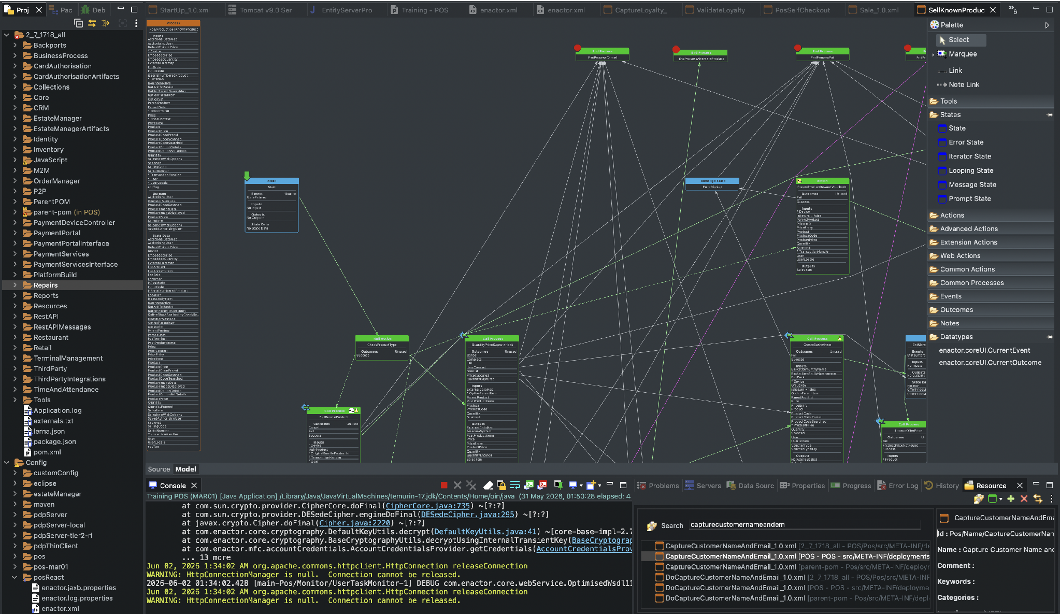
Entire Enterprise codebase, visual at every level
Every function and process is visual no matter how complex. Easily search and find every function that's been built and instantly understand how it works.
Change and Extend anywhere
Drag and drop tools to add functionality anywhere, in the solution using new code or re-usable functions. Add in new stateless functions, API calls, other integrations Database interactions and any new code that you need.
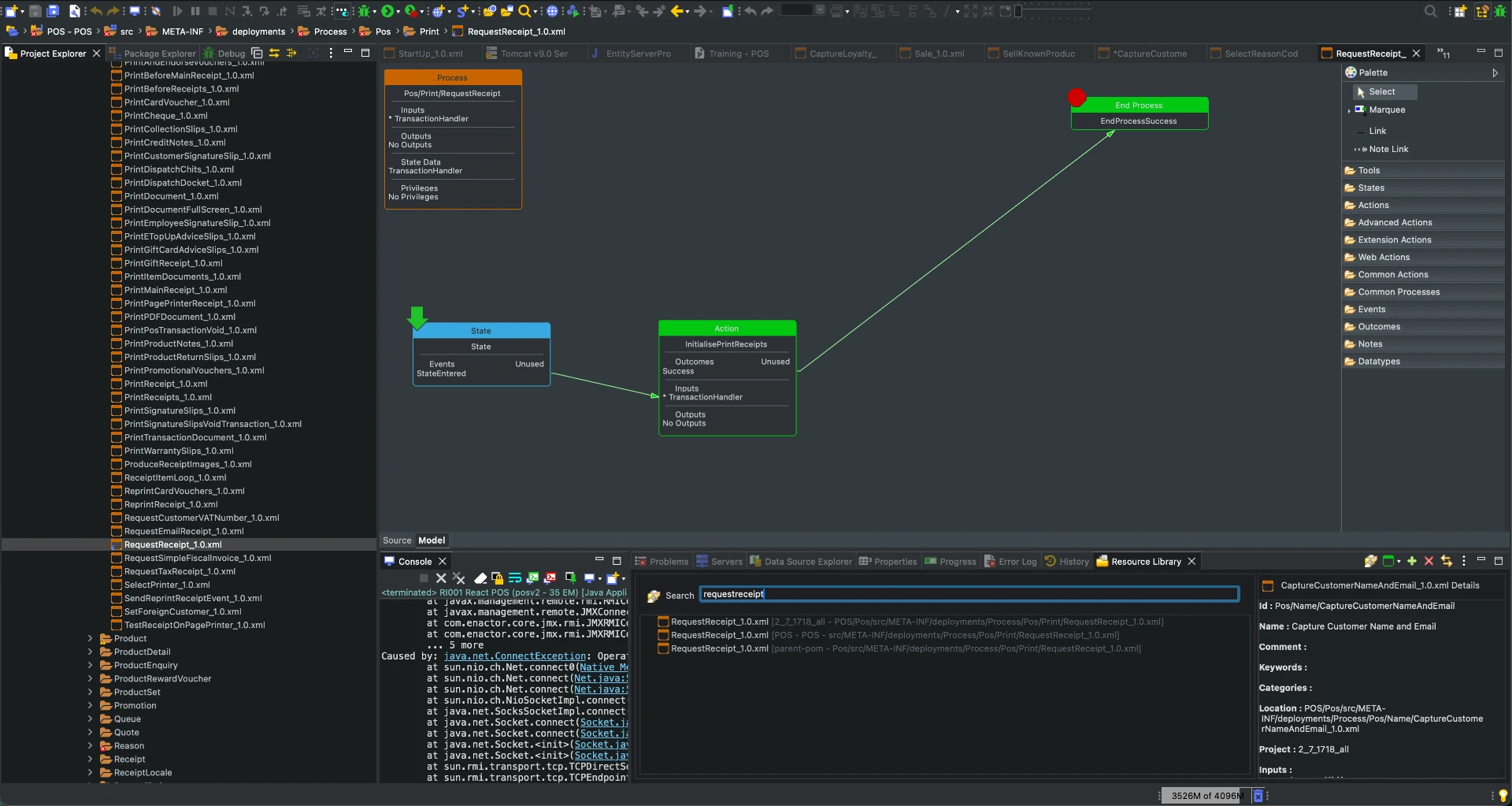
Use libraries of thousands of reusable Enactor code
Drop in and reuse any bit of code that's been built before and add to the libraries yourselves.
Stateless functions
Proven business logic, ready to drop in
React components
UI building blocks for every screen
Microservices
Deployable services, versioned and owned
API connectors
Pre-built integrations and API calls
Easily Split Development
Among Teams
Low-code lets you split work along the framework's own boundaries. Every process, service and screen is a separate, visual component with a clear interface. Split teams into domains, or functional areas and have the work completely independent but on a standardised codebase and component library.
POS & SCO
Promotions & Pricing
Customer & Loyalty
Inventory & Stock
Payments & Tenders
Delivery & Click & Collect
Build from the CLI
Explain the change in natural language and AI generates processes, actions and tests inside the framework for your team to review. Much more powerful
See everything AI builds
Explain the change in natural language and AI generates processes, actions and tests inside the framework for your team to review. Much more powerful
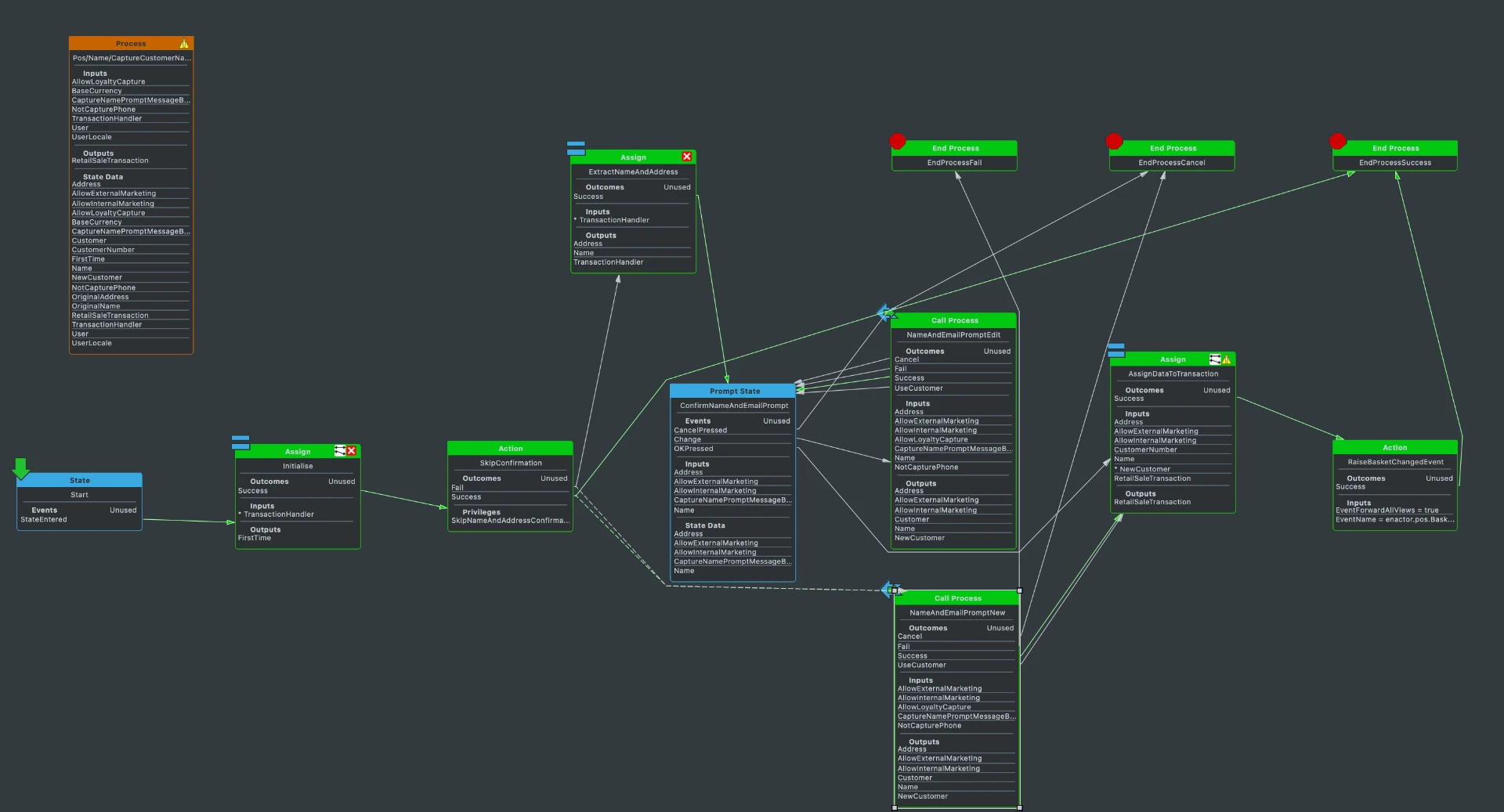
AI knows best practice, collaborate and improve
AI builds with Enactor best practice and design patterns built in — it knows which components to reuse, which extension points to write at and which APIs to call, so nothing turns into AI slop.
Keep all the Enactor Framework Benefits
Everything AI creates is built inside the Enactor framework, so it carries every benefit your team already relies on: reusable components, maintainable code, true collaboration between people and agents, and the same deployability as anything else you ship. Nothing AI builds sits outside the platform.
"Capture customer name and email at checkout, and validate loyalty."
AI alone isn't enough.
Enterprise AI-development needs a framework.
Generic AI coding tools produce impressive demos — but in enterprise applications, unstructured AI output quickly becomes unmaintainable. Without shared conventions, generated code can't be reviewed, reused or trusted at scale. A framework gives AI the structure it needs to be genuinely effective.
Structure AI can build within
AI generates code inside a proven architecture of processes, actions and services — so every output fits the enterprise, not just the prompt.
Reviewable, testable, trustworthy
Framework-based output is consistent and inspectable. Your teams can govern what AI produces — a hard requirement for enterprise systems of record.
Reusable at scale
What AI helps you build once, every team and product reuses. The framework turns AI speed into lasting enterprise value instead of throwaway code.